
Faculty’s news
Global Signature Course 2026: LHU and Universitas Esa Unggul Students Explore Intercultural Communication in the AI Era
On the afternoon of June 27, 2026, from 13:00 to 15:00, the Global Signature Course 2026 with the theme “Artificial Intelligence and Intercultural Communication: Enhancing Global Competence in English Language Education” was held online via Zoom with the participation of more than 80 students from Lac Hong University and Universitas Esa Unggul, Jakarta, Indonesia. Most of the participants were students majoring in English Language, English Language Education, and several other fields with an interest in international communication, artificial intelligence, and global citizenship competence.
The activity was organized by Universitas Esa Unggul, with presentations delivered by Dr. Ria Saraswati from Universitas Esa Unggul, Indonesia, and Mr. Hoang Vinh Loc, M.A., lecturer at the Faculty of English Language, Lac Hong University, as an invited speaker. This was one of the meaningful international academic activities that contributed to realizing the cooperation goals within the framework of the Cintana Alliance and the Powered by ASU orientation, aiming to expand the global learning environment, enhance English-medium academic experiences, and develop students’ international integration competence.
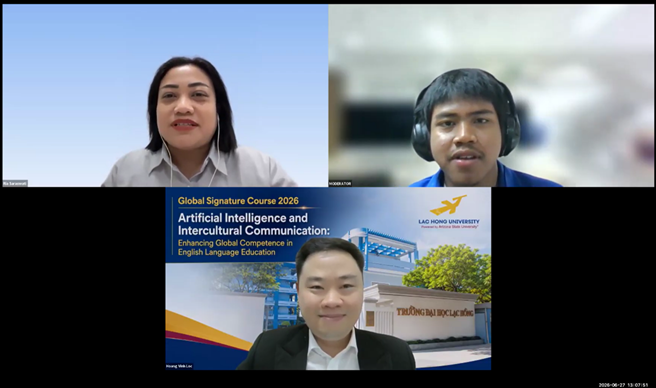
Dr. Ria Saraswati, Mr. Hoang Vinh Loc, and the moderator at the Global Signature Course 2026
Expanding Understanding of Culture, Identity and Global Citizenship
Opening the program, Dr. Ria Saraswati presented the topic “AI and Intercultural Communication: Bridging Cultures, Building Connections,” focusing on the relationship between artificial intelligence, culture, identity and intercultural communication in the context of globalization. Through her sharing, students were guided to understand that culture is not only customs, traditions or external expressions, but also includes value systems, beliefs, norms, behaviors and the ways people communicate in different social contexts.
One of the highlights of the presentation was the concepts of identity and digital identity. Dr. Ria Saraswati emphasized that in the digital era, personal identity is expressed not only through language, nationality or cultural background, but also through the way each person presents themselves, interacts and builds their image in the online environment. This is especially important for university students, who are increasingly participating in international classes, online academic forums and multicultural working environments.
In addition to the theoretical part, Dr. Ria Saraswati also helped students identify factors that may influence intercultural communication, such as communication styles, levels of directness and indirectness, individual and collective values, perceptions of time, respect and ways of resolving misunderstandings. Through a discussion situation related to Indonesia and Vietnam, students had the opportunity to think about cultural differences in communication, the use of AI tools to support translation, as well as the limitations of technology when dealing with cultural nuances.

Dr. Ria Saraswati presents on AI and intercultural communication, emphasizing the role of culture, identity and global citizenship
From Accurate English to Responsible Communication in the AI Era
Continuing the program, Mr. Hoang Vinh Loc, M.A., lecturer at the Faculty of English Language, Lac Hong University, presented a sharing session on the topic “Intercultural Perspectives in Global Communication.” The content focused on the changes in global communication in the AI era and the role of English, intercultural awareness and human judgment in building meaningful communication.
The speaker emphasized that global communication today is becoming faster, more digital, more multilingual and more AI-supported. Students can use AI to translate, edit, summarize, practise and prepare for international communication situations. However, as AI becomes more deeply involved in the communication process, learners should not only ask the question “Is my English correct?”, but also think more deeply: “Is this message appropriate?”, “Does it express my intended meaning?”, “Does it respect the listener and the cultural context?”
Through the metaphor of the iceberg, the presentation showed that language, vocabulary and grammar are only the visible parts of communication. Beneath that surface are culture, context, nuance, relationship, respect and meaning. An English sentence may be grammatically correct but still inappropriate if it does not take into account the relationship between the speaker and the listener. For example, the sentence “Send me the file today” may be structurally correct but can easily sound too direct; in many academic or workplace contexts, the expression “Could you please send me the file by the end of today?” would be more polite and appropriate.
From there, the speaker expanded the issue to the two-sided role of AI in global communication. AI can act as a bridge, helping overcome language barriers, creating a personalized practice environment, providing quick feedback and simulating intercultural communication situations. However, AI can also become a filter that removes cultural nuances, creates bias, or makes the message too generic and no longer reflects the writer’s personal voice. Therefore, learners need to form the habit of checking AI-assisted messages through three questions: whether the message conveys their intended meaning, whether it is appropriate for the recipient and the situation, and whether it still sounds like their own voice.
The sharing session also connected the content with UNESCO’s AI competency frameworks for students and teachers. Accordingly, students not only need to know how to use AI tools, but also need to develop a human-centered mindset, ethics in using AI, basic understanding of AI applications and the ability to evaluate the impact of AI systems on different user groups. For teachers, AI does not make the teacher’s role less important; on the contrary, teachers increasingly need to guide learners in verifying information, identifying bias, protecting privacy, considering cultural nuances and using AI responsibly.
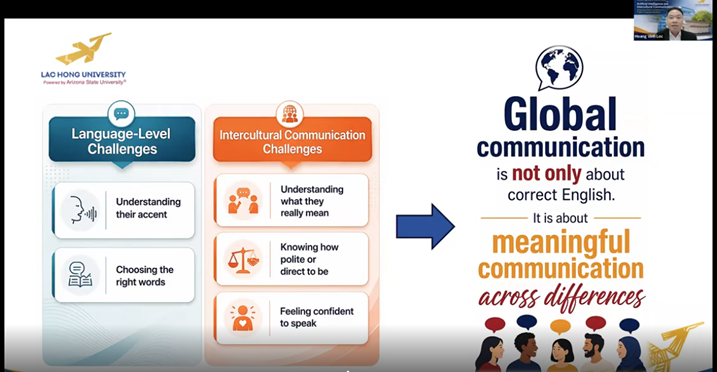
Mr. Hoang Vinh Loc, M.A. shares about global communication, intercultural awareness and responsible AI use in English language education
An Interactive International Learning Space for Students from the Two Universities
More than an academic sharing session, the Global Signature Course 2026 also created a highly interactive international learning space. Throughout the program, students were encouraged to answer questions, share personal viewpoints, discuss cultural situations and reflect on how to use AI in real-life communication.
Activities such as Think – Pair – Share, the Indonesia – Vietnam situation discussion, reflection questions on digital identity and the Quick Check on checking AI-assisted messages helped students practise critical thinking, express ideas in English and develop a sense of responsibility when communicating in a multicultural environment. In particular, the final question of the program about “one human quality that AI should not replace in global communication” opened up many profound thoughts on empathy, respect, honesty, responsibility and human judgment.
With the participation of more than 80 students from the two universities, the program provided learners with an opportunity to experience an international academic environment right on an online platform. It was also an opportunity for students to build confidence in using English, broaden their understanding of different cultures and become more aware of the role of technology in learning, communication and global cooperation.
Affirming the Internationalization Orientation within the Framework of the Cintana Alliance and Powered by ASU
The success of the Global Signature Course 2026 continued to affirm the significance of international cooperation activities in improving training quality and expanding learning experiences for students. In the context of Lac Hong University implementing the Powered by ASU orientation and participating in the Cintana Alliance network, programs such as the Global Signature Course contribute to bringing students closer to an international academic environment, where English is not only a subject of study but also a tool for connecting, learning and participating in global issues.
Through the theme Artificial Intelligence and Intercultural Communication, the program helped students become more aware that global competence in the digital era does not lie only in using English or AI tools proficiently. More importantly, learners need to know how to communicate responsibly, respect differences, understand cultural contexts and maintain their personal voice when using technology.
This activity not only brought new knowledge about AI and intercultural communication, but also contributed to fostering students’ English competence, digital mindset, intercultural competence and international integration readiness. These are essential competencies that help students be ready to adapt to increasingly open learning, working and communication environments in today’s connected world.
Global Signature Course
